
Auto dialers have become an essential tool for call centers, outbound sales teams, telemarketing operations, customer support centers, and outreach campaigns of all sizes. They help businesses reach more customers, increase agent productivity, and optimize operational efficiency — all while reducing manual dialing errors and wait time.
While commercial auto dialer software platforms offer powerful features, open-source and low-cost alternatives provide flexibility, customization, and cost savings that appeal to businesses with tight budgets or specific technical requirements.
In this guide, we explore the best open-source and low-cost auto dialer options available today, explain the key features to look for, and help you choose the right solution for your needs.
What Makes Open Source Auto Dialers Stand Out?
Open-source auto dialers continue to be relevant because they offer advantages that closed commercial systems often lack:
Cost Efficiency
Open-source platforms are typically free to download, install, and use. Even when optional paid support or hosting is added, the total cost of ownership is often far lower than proprietary systems.
Full Customization and Control
With access to the source code, businesses can tailor the dialer to meet specific workflows, compliance rules, branding requirements, and integrations.
Flexibility in Deployment
Open-source dialers can be self-hosted or deployed in cloud environments, giving organizations control over infrastructure, data privacy, and security settings.
Integration-Friendly
Unlike some commercial dialers with closed APIs, open-source systems often support open standards, enabling seamless integration with CRMs, reporting tools, messaging platforms, and AI services.
Types of Auto Dialers You Should Know
Auto dialers typically fall into the following categories:
Predictive Dialers
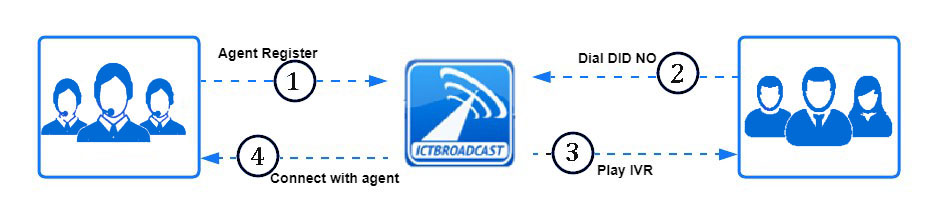
Predictive dialers maximize agent talk time by predicting when agents will be free and dialing multiple numbers ahead of time. These systems aim to connect agents directly with live calls, reducing idle time.
Progressive Dialers
Progressive dialers dial one call per available agent. They are more conservative than predictive dialers and reduce dropped calls or unanswered connections.
Preview Dialers
Preview dialers give agents customer details before the system places a call. This mode is useful when context or personalization is important.
Modern platforms often allow switching between dialing modes based on campaign goals.
Key Features to Look for in an Auto Dialer
When comparing auto dialer options, consider whether the solution offers:
✔ Predictive, progressive & preview dialing modes
✔ Call recording, call monitoring, and supervisor dashboards
✔ Real-time analytics and reporting
✔ SIP and WebRTC support for browser-based agents
✔ CRM integration and open APIs
✔ Compliance capabilities like DNC, call throttling, and local regulation support
✔ Multi-tenant and multi-campaign support
✔ Click-to-call and cloud communication features
These features define the usability, scalability, and long-term value of your auto dialer investment.
Best Open Source and Low-Cost Auto Dialers:
ICTDialer — Top Recommended Open Auto Dialer
ICTDialer is one of the top modern and versatile open source auto dialer software systems available today. Designed for both small teams and large call centers, it balances ease of use with advanced features.
🔹 Why ICTDialer is recommended:
- Native support for predictive, progressive, and preview dialing
- WebRTC support for browser-based calling
- Fax to Email & Email to Fax supported
- Real-time dashboards and agent monitoring
- Extensive reporting and analytics
- Built-in CRM integrations and open API
- Multi-tenant architecture for service providers
- Designed for modern compliance needs
ICTDialer is ideal whether you’re building an in-house call center or delivering hosted dialer services to clients. Its architecture enables rapid customization and integration into existing communication systems.
OSDial
OSDial is a classic open-source dialer based on the Asterisk telephony platform. It has been widely used in traditional contact centers.
👍 Pros:
- Completely free and open source
- Well-understood by developers familiar with Asterisk
⚠ Cons:
- Older user interface
- Limited modern features like WebRTC or cloud deployment
- Requires experienced technical resources
OSDial remains useful for legacy PBX-based environments but lacks some of the modern usability and integration features found in newer platforms.
Newfies-Dialer
Newfies-Dialer is an open-source predictive dialer built on the FreeSWITCH engine.
👍 Pros:
- Effective for large voice campaigns and broadcasting
- Free and extendable
⚠ Cons:
- Not as feature-rich for full call center operations
- Limited CRM integrations out of the box
- Requires more technical setup
Newfies is best suited for focused outbound campaigns rather than general contact center use.
Low-Cost Commercial Alternatives
While not fully open-source, some low-cost auto dialers provide simplicity and ease of setup for smaller teams:
CallHippo
A basic outbound dialer suitable for startups and small businesses, with straightforward pricing and quick deployment. Best for simple use cases where full customization is not needed.
DialerHQ
A feature-rich dialer with advanced outbound and inbound capabilities. Offers a free trial but requires paid plans for ongoing use. Useful for teams that want quick setup without deep technical management.
How to Choose the Right Auto Dialer
To pick the best auto dialer for your organization, ask yourself:
🔍 1. What are your dialing goals?
- High-volume outbound campaigns?
- Contextual selling with preview mode?
- Call center with inbound/outbound balance?
👥 2. How many agents will you support?
Scalability needs change depending on team size and campaign strategies.
🛠️ 3. What is your technical ability?
Some open-source systems require server setup and maintenance expertise, while others are plug-and-play.
💼 4. Do you need integrations?
If you require deep CRM, helpdesk, or analytics integrations, ensure the dialer provides APIs and supported connectors.
⚖️ 5. Are compliance features important?
Compliance with local regulations, Do-Not-Call lists, and throttling rules can be mission-critical.
Conclusion:
Open-source and low-cost auto dialers empower businesses of all sizes to run efficient calling campaigns without prohibitive licensing costs. Today’s best solutions combine flexibility, modern features, and integration capabilities that rival commercial systems.
If you’re evaluating auto dialers, ICTDialer stands out as a strong first choice thanks to its comprehensive feature set, developer-friendly design, and scalable architecture.