
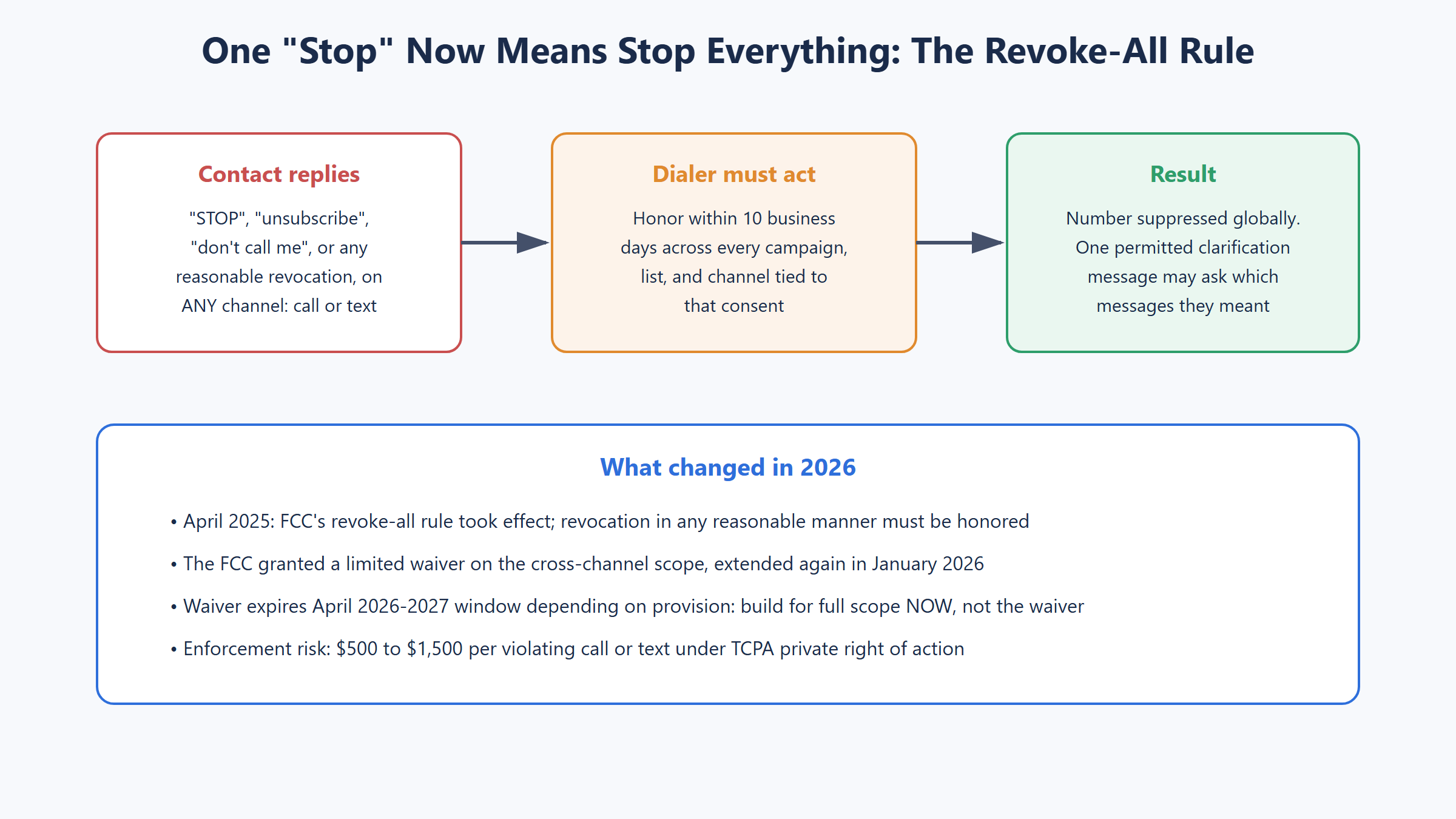
A quiet piece of FCC housekeeping this year deserves more attention than it got. The agency’s revoke-all consent rule, in force since April 2025, says that when a contact revokes consent in any reasonable way, that revocation applies broadly, across your campaigns and channels, and you have ten business days to honor it. Industry groups won a limited waiver on the trickiest cross-channel piece, and the FCC extended that waiver in January. Plenty of outbound teams read the extension as a reprieve. That’s the wrong read. Waivers expire; architecture is forever. If your auto dialer’s opt-out handling can’t already do the full rule, the extension is the time you’ve been given to fix it.
What Revoke-All Actually Demands
Three parts of the rule bite hardest for anyone running dialing campaigns. First, revocation counts in “any reasonable manner.” A texted STOP, a spoken “take me off your list” mid-call, an email reply, a message through your website. You don’t get to insist people use your designated opt-out channel.
Second, the revocation reaches sideways. A STOP reply to a text message doesn’t just kill texts; under the rule’s full scope it revokes consent for the calls tied to that same consent too. This cross-channel reach is exactly what the waiver temporarily softens, and exactly what returns when the waiver lapses.
Third, the clock is short. Ten business days from revocation to suppression, everywhere. If your opt-outs travel from an SMS platform to a spreadsheet to a monthly list scrub, you’re structurally unable to comply, and with TCPA statutory damages running $500 to $1,500 per violating call or text, a leaky opt-out pipeline is the most expensive plumbing problem in outbound calling.
The Architecture That Passes an Audit
The fix isn’t a policy document. It’s four layers of dialer plumbing, and they’re all buildable today.
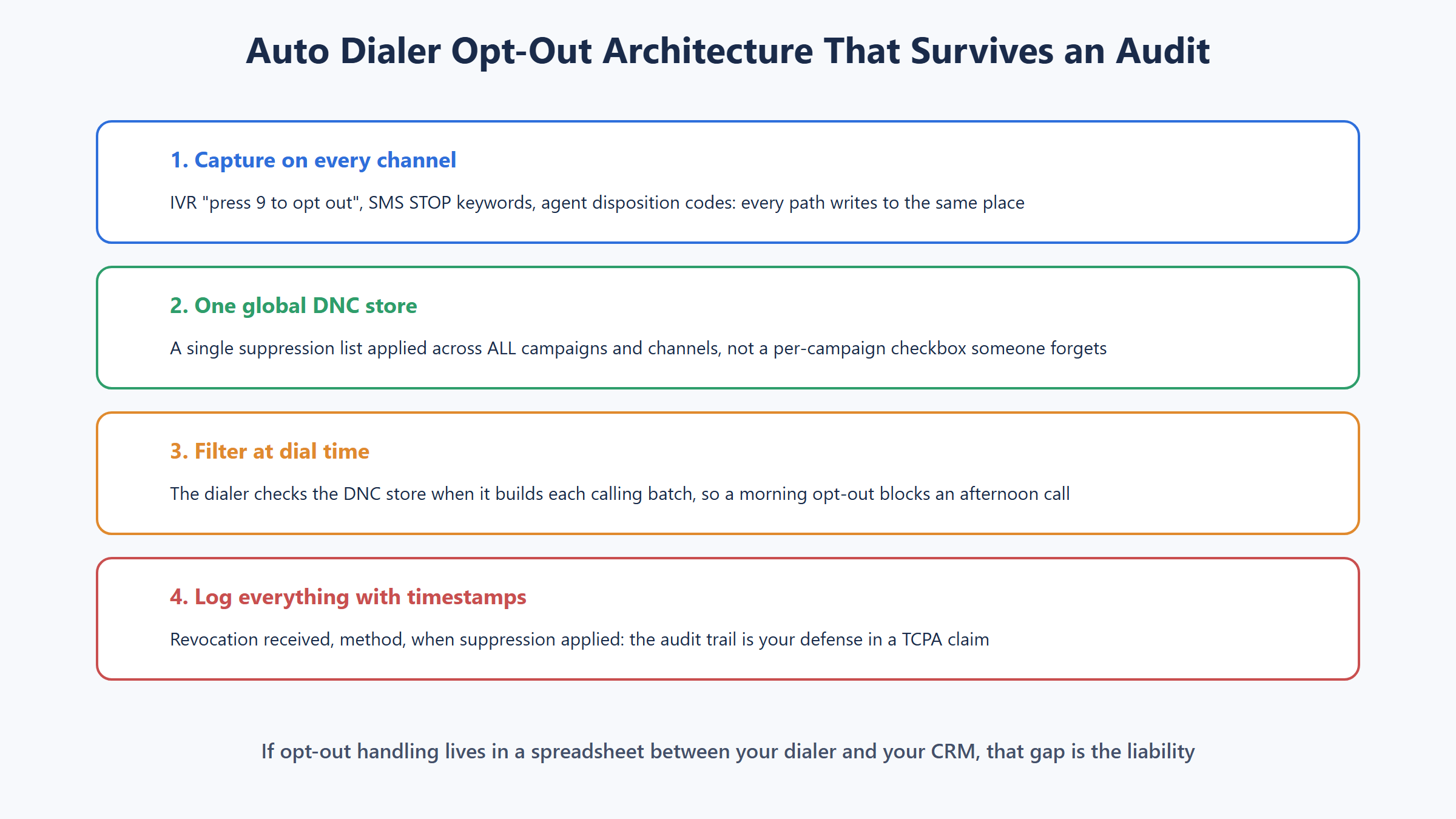
Capture on every channel. Your IVR needs a press-to-opt-out branch on every outbound campaign. Your SMS side needs STOP keyword handling. Your agents need a one-click disposition code that means “revoked consent,” because a verbal request buried in call notes is a lawsuit waiting for discovery.
One global DNC store. This is where most setups fail. Opt-outs recorded per campaign leave the contact live in the other nine campaigns, which is precisely what revoke-all prohibits. Every capture path must write to a single suppression list that every campaign reads.
Filter at dial time. Scrubbing lists at import isn’t enough, because a contact who opts out on Tuesday morning is still sitting in the batch you imported Monday. The dialer should check the suppression store as it builds each calling batch, so revocations take effect in hours, not at the next import.
Log with timestamps. When the revocation arrived, through which channel, and when suppression applied. In a TCPA dispute, that log is the difference between a dismissed claim and a settlement negotiation.
This is a place where open source auto dialer software holds a real edge. When the DNC logic is code you can read and extend, wiring every capture path into one suppression store is an afternoon of configuration, not a feature request in a vendor’s backlog. ICTDialer’s FreeSWITCH based architecture keeps campaign control, contact lists, and DNC handling in one platform, so the opt-out captured by the IVR is the same record the next dialing batch checks.
Note: ICTDialer.com is the SaaS version of ICTContact, which is an Asterisk based platform. The open source ICTDialer project is a separate FreeSWITCH and ICTCore based project, available on GitHub at github.com/ictinnovations/ictdialer. The two share a name only.
Do This Before the Waiver Lapses
Run a simple drill this month. Text STOP to one of your own campaigns, then check how long that number stays dialable in your voice campaigns. If the answer is “until someone runs the monthly scrub,” you’ve found your project. Then trace every place an opt-out can enter: SMS, IVR, agent, email, web form, and confirm each one lands in the same suppression store the dialer reads at batch time.
The teams treating the waiver extension as extra runway to build are going to cruise through its expiration. The teams treating it as permission to wait are betting their margins on the FCC extending it forever. Regulators rarely do.
FAQ
What is the FCC revoke-all consent rule?
Effective April 2025, it requires callers to honor consent revocation made in any reasonable manner within ten business days, with the revocation applying across the campaigns and channels tied to that consent rather than just the one where it was received.
What did the FCC waiver change?
The waiver, extended in January 2026, temporarily delays the cross-channel scope, the requirement that an opt-out on one channel revokes consent on others. The core rule still applies, and the full scope returns when the waiver expires.
Can I send a message asking what the person meant?
Yes, one. The rule permits a single clarification message asking whether the revocation covers all message types, provided it contains no marketing. Silence means treat the revocation as covering everything.
How fast must an opt-out reach my dialer?
Legally, within ten business days. Practically, aim for same-day: dial-time filtering against a global suppression list closes the gap between a morning opt-out and an afternoon call, which batch scrubbing can’t.
What are the penalties for getting this wrong?
TCPA claims carry statutory damages of $500 per violation, tripled to $1,500 for willful violations, per call or text. Class actions aggregate those quickly, which is why audit logs of revocation handling matter as much as the suppression itself.