
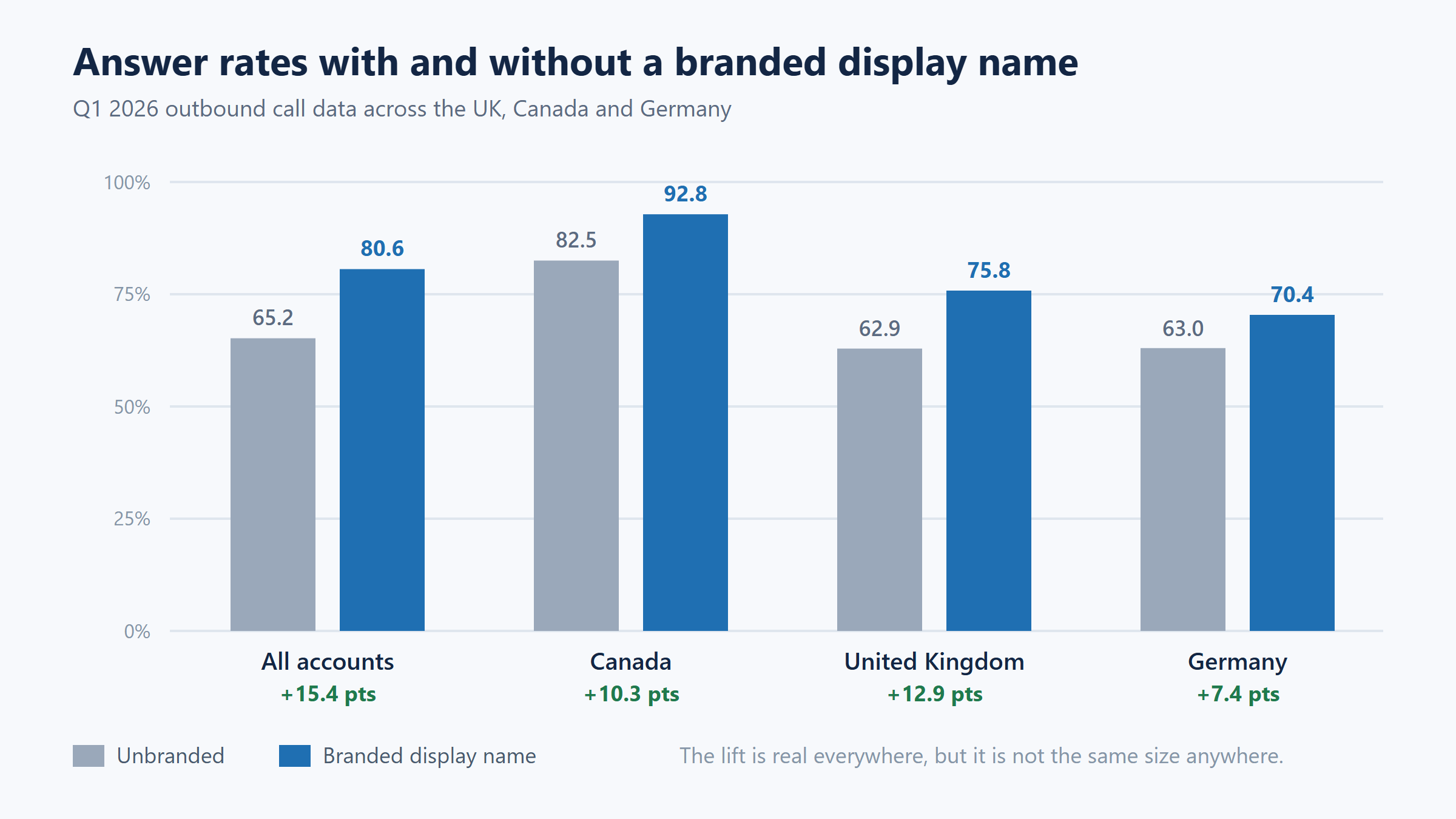
Branded calling has entered public beta in Canada, Germany and the UK, and the vendor released Q1 2026 numbers alongside it: an 80.6 percent average answer rate for calls carrying a branded display name against 65.2 percent for unbranded ones. If you run auto dialer software that touches those three markets, the interesting part is not the headline. It’s that almost nothing you built for STIR/SHAKEN compliance transfers.
What the Q1 2026 numbers actually say
Break the average apart and it stops being one story. Canada went from 82.5 percent unbranded to 92.8 percent branded. The UK moved 62.9 to 75.8. Germany, the most reserved of the three, went 63.0 to 70.4. So the lift ranges from about seven points to nearly thirteen depending on which border your call crosses.
Two caveats before anybody builds a forecast on this. First, it is vendor-published data drawn from their own customer base, which skews toward businesses already organized enough to register a brand. Second, an answer is not a conversation, and it is definitely not a sale. I would treat these as directionally honest and plan against the low end.
For context on why any of this moves at all: Hiya’s State of the Call research this year put 87 percent of consumers in the camp of unlikely to answer a number they don’t recognize. That is the wall. Branded calling is the first mechanism in a while that goes at it directly rather than just trying to avoid a spam label.
Why STIR/SHAKEN work doesn’t carry over for auto dialer software abroad
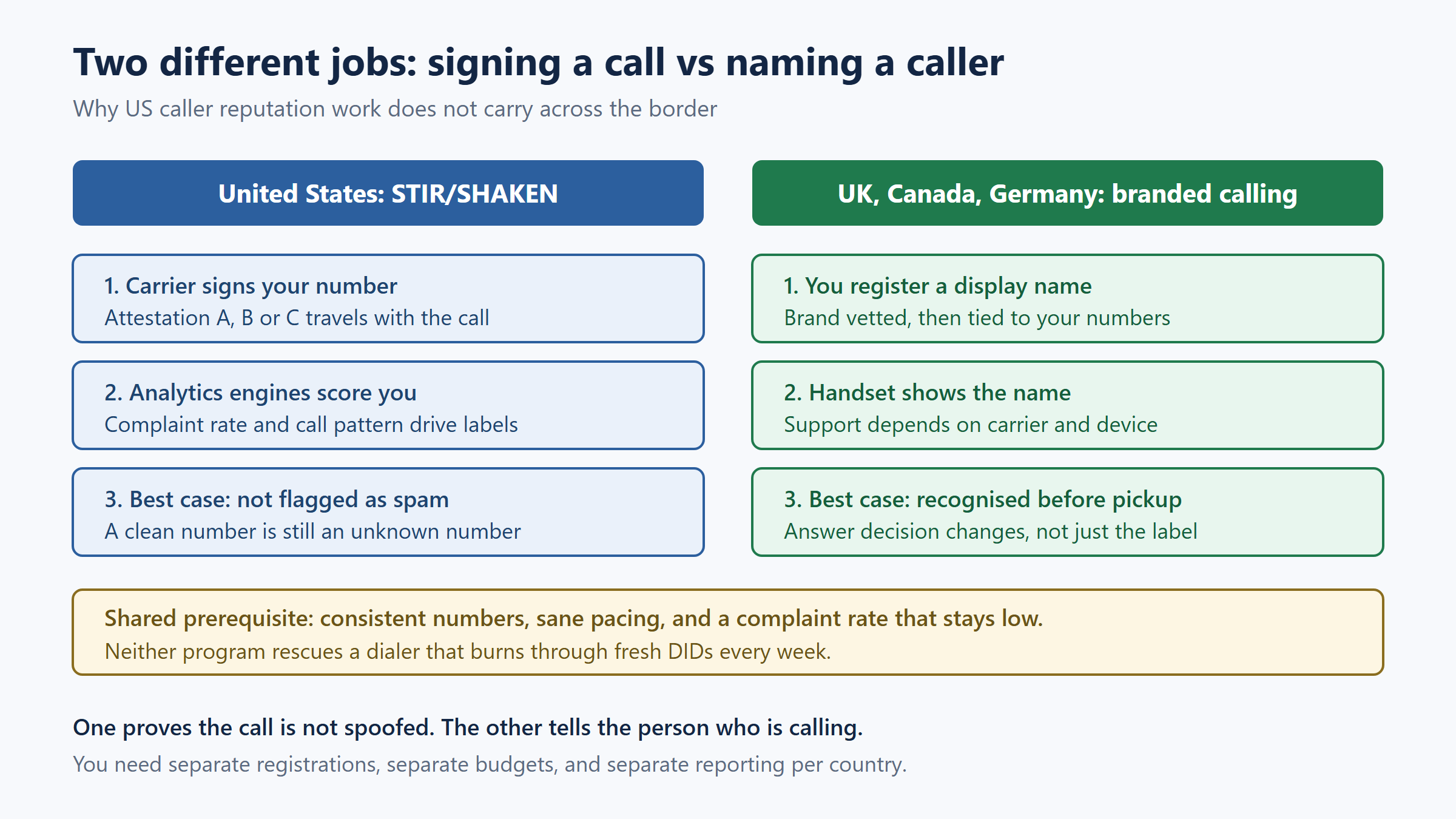
US caller reputation work is a signing problem. Your carrier attests to the fact that you have the right to use a number, that attestation rides along with the call, and analytics engines fold it into a score that decides whether a handset says Scam Likely. The 2026 TNS Robocall Report has authentication running at roughly 85 percent of voice traffic between Tier-1 carriers, so at this point being signed is table stakes rather than an advantage.
Branded calling solves a different problem. Nobody is verifying that you own the number in order to display your name. You register a brand, it gets vetted, and it gets tied to your numbers so the handset can render something a human recognizes. One process proves a call is not spoofed. The other tells the person on the other end who is ringing them.
That distinction has a practical consequence teams keep missing. Your US attestation status, your carrier relationships, your remediation history with the analytics providers: none of it follows you to Frankfurt. You register separately, per country, and you budget separately.
Uneven gains should change where you dial first
Here’s the operational read. Canada already answers the phone. Starting from 82.5 percent, the ten point gain lands on a base that was healthy to begin with, so branding there is optimization rather than rescue. The UK is where I’d spend first: a thirteen point jump off a 62.9 percent base is the difference between a campaign that pays for itself and one that doesn’t.
Germany is the one to model carefully. Seven points is real, but it is the smallest lift of the three, and German outbound has its own consent culture and regulatory temperament sitting behind the number. If your German list quality is shaky, a display name is not going to carry the campaign.
Consider a twelve-agent outbound team splitting effort across all three markets. Reallocating dials toward the UK for a quarter, purely because the branding lift is biggest there, is a cheaper experiment than adding headcount and it answers a question you’ll need answered anyway.
What to change in your dialer this quarter
- Freeze your caller ID set per country. Brand registration ties a name to specific numbers, so a dialer that rotates DIDs aggressively will undo the thing you just paid for.
- Split reporting by destination country. A blended answer rate across three markets will hide exactly the differences shown above.
- Check handset and carrier coverage before promising results internally. Display name support is not universal, and a share of your dials will land on devices that show nothing.
- Keep pacing conservative while you measure. Abandoned calls raise complaint rates, and complaints are the fastest way to lose a brand registration you just earned.
- Re-baseline before you switch anything on. Without two weeks of clean unbranded data per country you’ll have no way to prove the lift.
- Confirm your local consent basis separately. Branding changes whether people answer, not whether you were allowed to dial.
Most of that is configuration rather than engineering. An open source stack helps here mainly because per-country caller ID rules and campaign-level reporting are things you can change yourself instead of filing a feature request. The FreeSWITCH-based architecture behind ICTDialer exists partly for that reason.
Note: ICTDialer.com is the SaaS version of ICTContact, which is an Asterisk based platform. The open source ICTDialer project is a separate FreeSWITCH and ICTCore based project, available on GitHub at github.com/ictinnovations/ictdialer. The two share a name only.
What branded calling won’t fix
A name on the screen raises the odds someone picks up. It does nothing about what happens next. If your list is stale, if the agent takes four seconds to start talking, or if the offer is wrong for that market, a higher answer rate just means more people hearing a bad pitch.
There’s a reputational edge to this too. Getting recognized more often cuts both ways, because now the calls people resent are attached to your brand instead of an anonymous number. Teams running heavy volume with thin targeting should probably fix targeting first. That’s not the advice a vendor blog usually gives, but it’s the one I’d want.
The dull prerequisites still decide most outcomes: consistent numbers, sane pacing, clean data, and agents who are ready when the call connects. Our roundup of open source auto dialer options goes through how different platforms handle those basics, and the WebRTC agent setup matters more than people expect once answer rates climb and connect times start mattering.
Frequently asked questions
What is branded calling?
It’s a program that displays your verified business name on the recipient’s handset during an inbound ring. You register the brand, it gets vetted, and it gets associated with the numbers you dial from. It is separate from caller name lookup services and separate from call authentication.
Is branded calling the same as STIR/SHAKEN?
No. STIR/SHAKEN is a US framework for cryptographically signing calls so carriers can tell whether a number is being spoofed. Branded calling adds identity for the person answering. You can be fully authenticated and still show up as an unknown number.
Does branded calling work in every country?
Not yet. The current public beta covers Canada, Germany and the UK, with availability depending on the recipient’s carrier and device. Coverage keeps expanding, so check per market rather than assuming a global rollout.
How much does the answer rate actually improve?
Q1 2026 data put the branded average at 80.6 percent against 65.2 percent unbranded, but the country split ran from about seven points in Germany to nearly thirteen in the UK. Model the low end and measure your own baseline before committing budget.
Will branded calling stop my calls being marked as spam?
Not on its own. Spam labelling is driven by complaint rates and calling patterns. A registered brand can be withdrawn if your behaviour looks abusive, so the underlying discipline around pacing and consent still does the heavy lifting.
Do I need to change my dialer to support it?
Usually not at the code level. What matters is operational: a stable set of registered numbers per country, per-country reporting, and pacing controls tight enough to keep complaints low.
Related resources
- 10 best open source auto dialer software solutions
- ICTDialer: FreeSWITCH-based open source auto dialer
- WebRTC agent interface
- Free auto dialer software for outbound sales
- 10 best open source unified communications platforms
Run outbound on a stack you can actually tune
Per-country caller ID rules, campaign-level pacing and reporting you can split by destination are configuration problems, and they’re much easier when you own the platform. ICTDialer is an open source predictive dialer built on FreeSWITCH, covering voice, SMS, fax and email campaigns from one system. Take a look at what ICTDialer does, or read the platform overview if you’re weighing a migration. For deployment questions, reach our team through the support desk.