
If you read last week that the FCC has changed the TCPA revoke-all rule, you read something wrong. The document everyone is quoting is a draft, circulated on 9 September for a vote at the Commission’s open meeting on 30 September 2026. Until that vote happens, the rule you have to follow is the one you are already following.
How to check this yourself in ten seconds
Open the draft, FCC-CIRC 2609-05 in CG Docket No. 02-278, and look at the header. It reads:
Adopted: [ ] Released: [ ]
Empty brackets. The FCC fills those in when a document is actually adopted and released. The cover text says the item “has been circulated for tentative consideration by the Commission at its September 30, 2026 open meeting”, and adds that the Commission’s ultimate resolution may differ from what the draft says.
That has not stopped a fair number of write-ups describing it as adopted, or as a final rule issued on 9 September. If you are planning a compliance change off one of those summaries, you are planning off a document that could still be edited or voted down.
What it would actually change
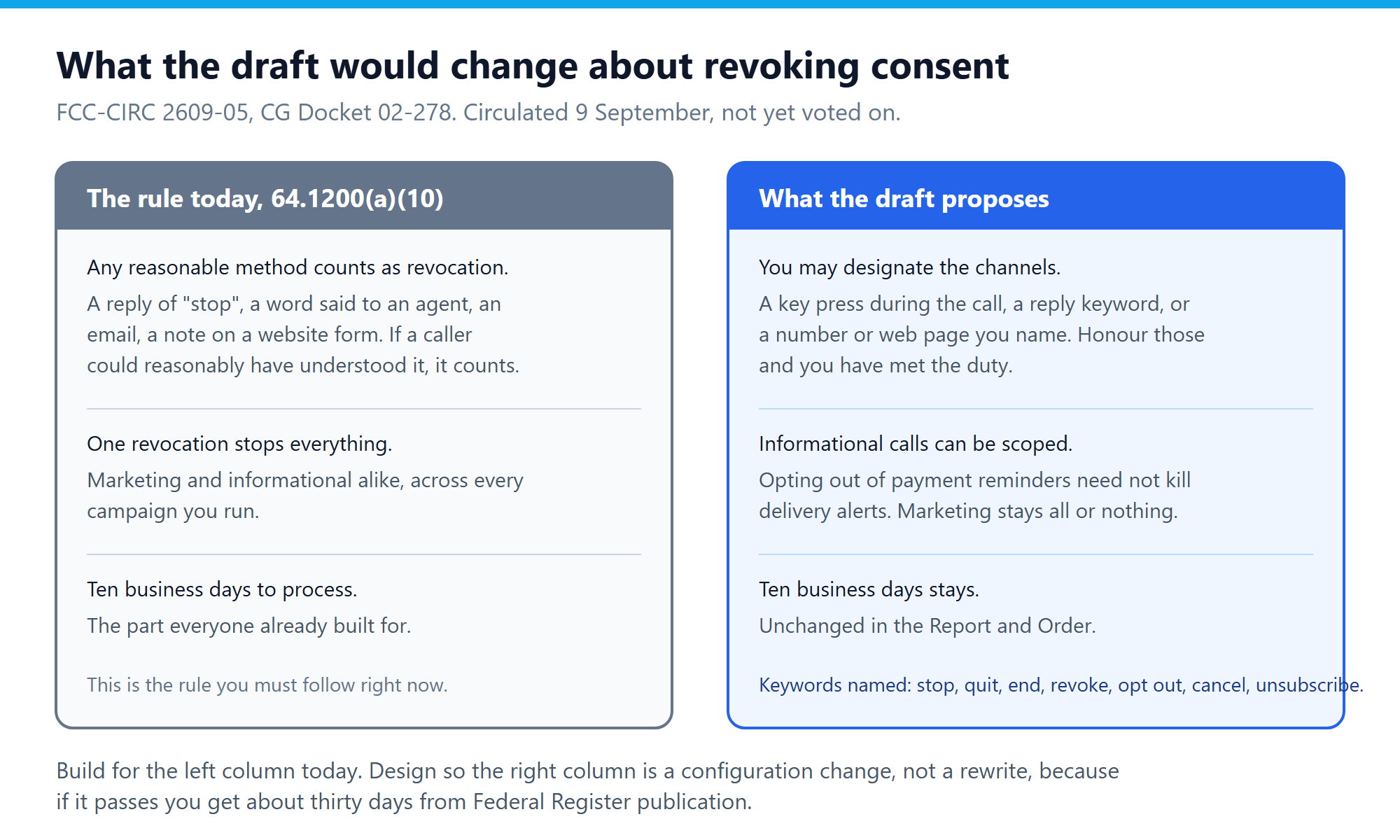
Today, under 47 CFR 64.1200(a)(10), any reasonable method of revoking consent counts. Somebody says “take me off your list” to an agent, replies with a word you never anticipated, or writes it on a form, and it counts. That is a hard thing to build for, because you are effectively promising to catch revocation in any form it arrives.
The draft would let you designate the channels. A key press during the call, a reply keyword, or a phone number or web page you nominate. Honour revocations arriving through those and you have met the duty. The draft names the keywords it has in mind: stop, quit, end, revoke, opt out, cancel and unsubscribe.
It would also let you scope revocation for informational calls. Someone opting out of payment reminders would not automatically be opted out of delivery notifications. Marketing does not get that treatment, and a revocation there still stops all future telemarketing robocalls and texts from you.
The ten business day processing window stays as it is.
The dates that matter
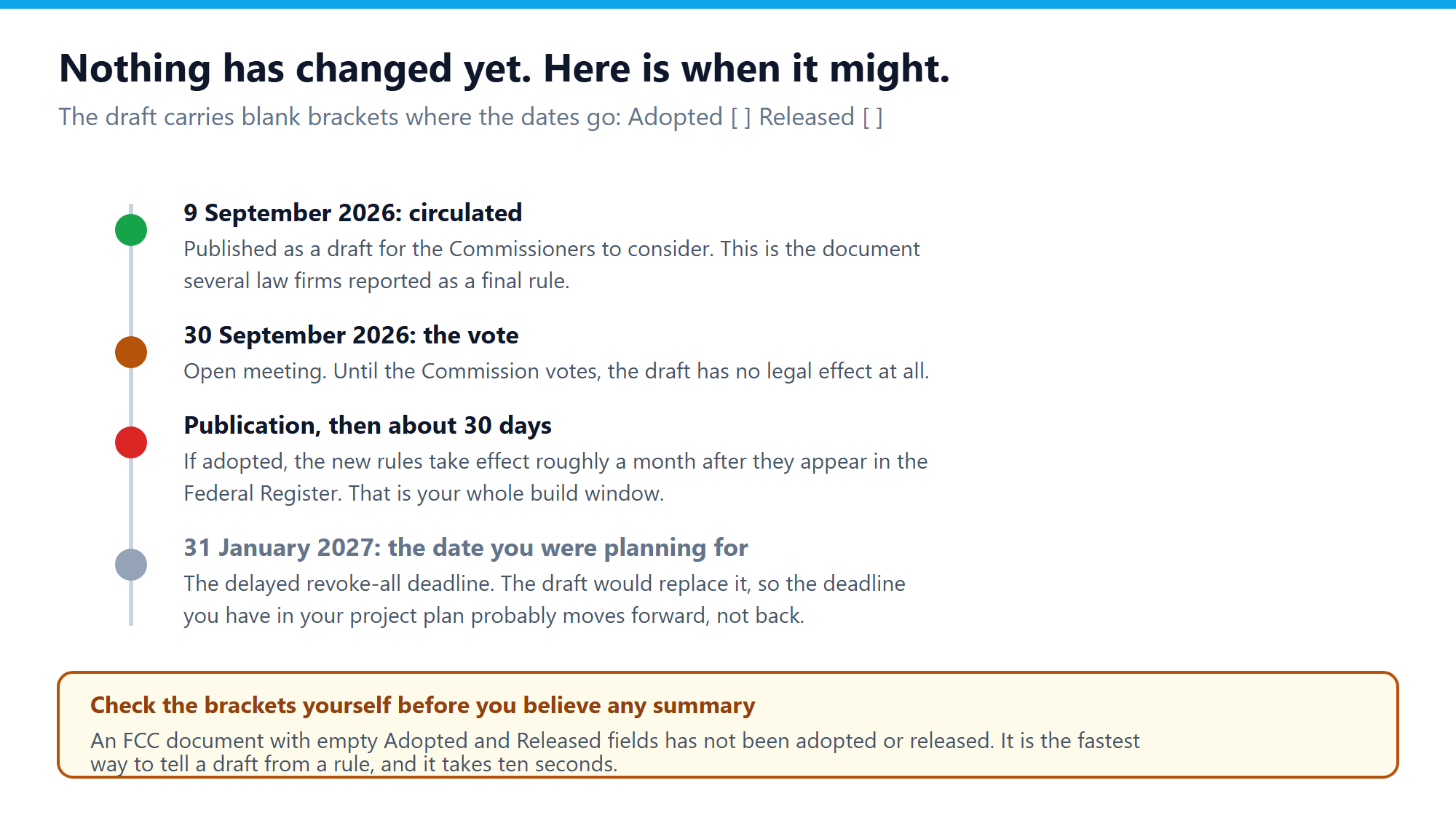
Here is the part worth putting in your calendar. If the draft is adopted, the new rules take effect about 30 days after they appear in the Federal Register. Not January. That would supersede the 31 January 2027 revoke-all date that most teams have been building toward, and pull the work forward by months.
So the risk is not that this passes. The risk is that you treated 31 January as the deadline, and the real one lands in November.
What to do while it is still a draft
Keep building for the rule as it stands, because that is the rule you are judged against today, and because the looser version might not arrive. Someone replying “please stop calling” in a form you did not anticipate still revokes consent right now.
But design so the change is configuration rather than a rewrite. Three things make the difference in an auto dialer:
- Record where each revocation came from. If channel starts to matter legally, you want a field saying whether it arrived by key press, by keyword, through the website or from an agent. Retrofitting that onto historical records is the expensive version of this project.
- Tag suppression entries by campaign category. If scoping arrives, you need to be able to say this person opted out of reminders but not alerts. A single global do-not-call flag cannot express that, and splitting it later means guessing at intent you never captured.
- Handle the keyword list as data. The seven words in the draft are not the seven you will end up with, and they are not the same across every state. A list you can edit beats a list compiled into your message handler.
None of that is wasted if the draft fails. Knowing how a revocation reached you and which campaign it applied to is useful record keeping regardless, and it is exactly what you want in front of you if somebody sues.
The further notice, which is a separate thing again
Bundled with the Report and Order is a Further Notice of Proposed Rulemaking, which is only a set of questions. It asks about shortening the processing window below ten business days, about ending one-way texting where a caller sends messages from a number that cannot receive replies, about whether an automated revoke-all method should be mandatory, and about how consent travels between affiliates and divisions of the same company.
That last one is the one to watch. If you run several brands from the same platform, the answer decides whether an opt-out from one reaches the others.
Frequently asked questions
Is the revoke-all rule in force right now?
The underlying requirement in 64.1200(a)(10) is in force. The broader revoke-all provisions had been delayed to 31 January 2027, and this draft would replace them before that date arrives. Nothing in the draft itself is enforceable today.
How will I know if it passes?
The Commission votes at the 30 September open meeting. If adopted, a released version appears with real dates in those brackets, then publication in the Federal Register starts the clock. Watch the docket number rather than the commentary.
Should we stop honouring revocations that arrive by other routes?
No, and not even if this passes. The draft would let you designate channels, not ignore people. A recorded request you chose not to act on is the kind of fact that reads badly in front of a court, whatever the rule technically permits.
Does this affect texts as well as calls?
Yes. Robotexts sit under the same consent and revocation framework, which is why the keyword list matters so much. The further notice also asks specifically about one-way texting.
What about state rules?
They stack on top and none of this touches them. A mini-TCPA can impose its own consent and revocation requirements with its own private right of action, so federal compliance on its own is not a defence.