A company ran AI voice calls for nine days in December 2024, reached about 900 people, and has now agreed to pay $1.1 million to settle the class action that followed. In the same fortnight, two new lawsuits accused an insurer’s sales chain of placing AI calls without consent. If you’re about to put an AI voice agent on outbound calls, the lesson is simple: a pilot is a real campaign, and the TCPA treats it that way.
This post walks through the three cases, why the law sees an AI voice the same way it sees a recorded message, and five checks to run in your auto dialer software before the first AI call goes out.
The three cases, briefly
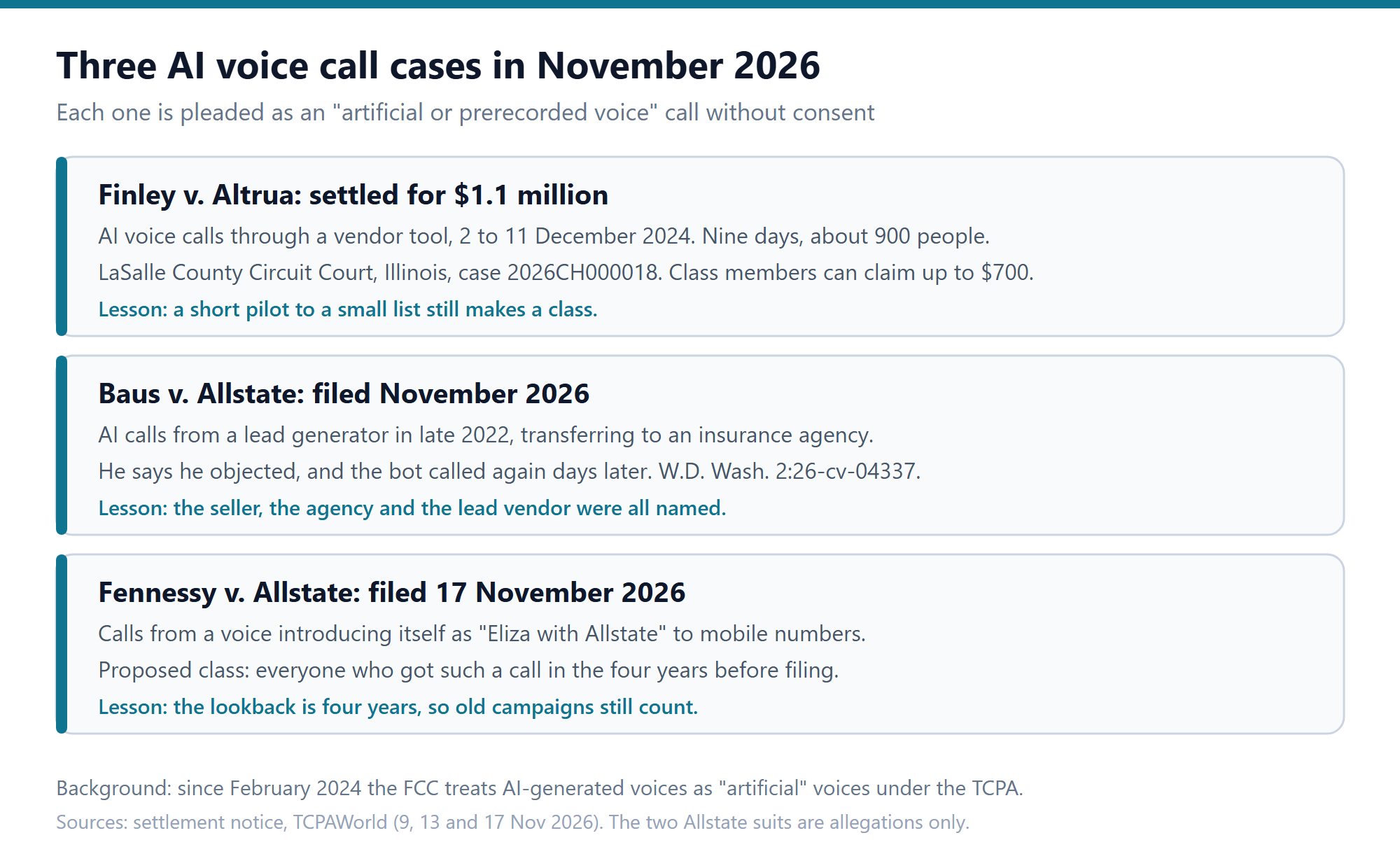
Finley v. Altrua (settled). Altrua HealthShare and Crown Administrators agreed to pay $1.1 million to settle a class action in the Circuit Court of LaSalle County, Illinois (case 2026CH000018). The class covers people who got calls placed by Crown Administrators on Altrua’s behalf using an AI voice tool between 2 and 11 December 2024. That’s nine days. TCPAWorld, which reported the settlement on 9 November 2026, puts the class at about 900 people, and the settlement notice says members can claim up to $700 each. The claim was the usual one: prerecorded or artificial voice calls to mobile phones without prior express consent.
Baus v. Allstate (filed November 2026). A Washington consumer sued Allstate, one of its agencies and a lead generator in the Western District of Washington (case 2:26-cv-04337), according to TCPAWorld’s 13 November report. He says AI voice calls started in late 2022, pitched insurance under a generic association name and tried to transfer him to the agency. He says he told the agency’s staff the calls broke the law, and the bot called again a few days later. These are allegations. Nothing has been decided.
Fennessy v. Allstate (filed 17 November 2026). A second class action, this time over calls from a voice introducing itself as “Eliza with Allstate”. The proposed class is everyone who got an artificial or prerecorded voice call about the company’s products on a mobile phone in the four years before filing. Again, allegations only.
Why an AI voice counts as a robocall
The TCPA doesn’t care how clever the voice is. It restricts calls made with an “artificial or prerecorded voice”, and in February 2024 the FCC issued a declaratory ruling (FCC 24-17) saying that voices generated by AI fall inside “artificial”. So a conversational AI agent that answers questions and books appointments sits in the same legal bucket as a recorded message.
That has three practical effects for anyone running an auto dialer:
- You need prior express consent before the call. For marketing calls, that means prior express written consent that covers this type of call from this seller. A form that agreed to “contact from a representative” is a weak foundation for an AI call.
- Damages are per call. The statute allows $500 per violating call, and up to $1,500 if a court finds the violation was willful or knowing. A nine-day run adds up fast.
- The lookback is long. Claims can be brought for four years. A campaign you ran in 2026 can still be the subject of a suit filed in 2030, which is exactly why the Fennessy class reaches back four years.
We covered the separate question of whether you must tell people the voice is AI in our post on state AI voice disclosure rules. Disclosure and consent are different requirements. Telling someone “this is an AI assistant” doesn’t fix a missing consent.
What these cases have in common
Read together, the three cases point at the same weak spots. None of them is about the AI being bad at conversation.
Pilots get treated as tests by the business, and as campaigns by the law. Altrua’s run lasted nine days. That’s the length of a trial most teams wouldn’t think twice about. The consent check, DNC scrub and calling hours need to apply to the first 500 numbers exactly as they would to the next 500,000.
The whole chain gets named. In Baus, the lead generator, the agency and the insurer are all defendants. If you buy leads, the person suing you won’t care that someone else collected the consent. You need to be able to produce it.
An ignored “stop” turns a weak claim into a strong one. The most damaging allegation in Baus is that the bot called back after the objection. Under the FCC’s rules a person can revoke consent by any reasonable means, including saying so on the call, and you have ten business days to honour it. When the FCC’s revised opt-out rules take effect on 25 November 2026, a revocation of telemarketing consent still covers all of your telemarketing calls. An AI agent that hears “don’t call me again” and carries on is the fastest way to a willful violation claim.
Five checks before an AI voice campaign dials
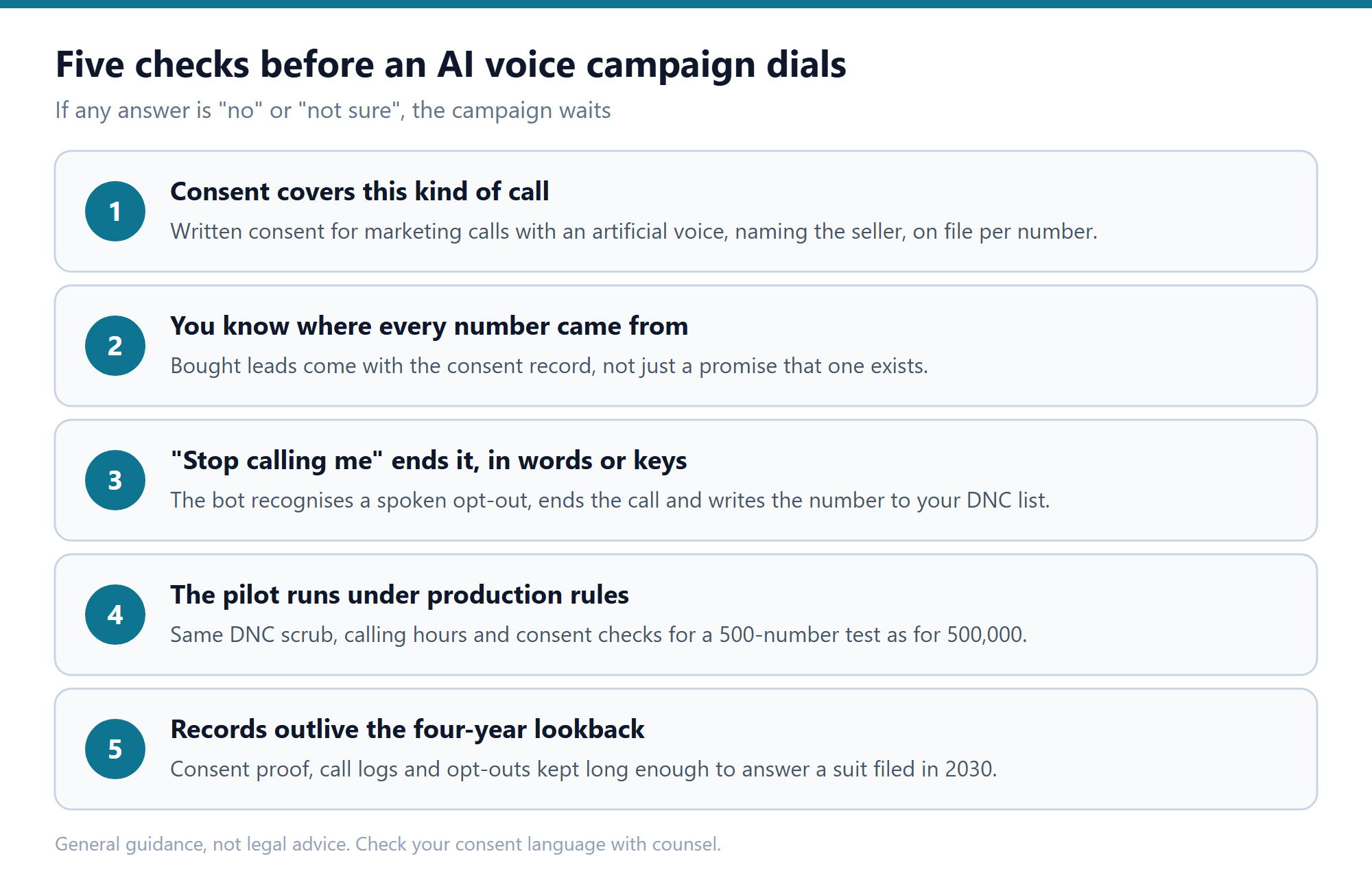
- Consent covers this kind of call. Check the actual wording people agreed to. For marketing, you want written consent to calls using an artificial or prerecorded voice, naming your company, stored against each number with a date and source.
- You know where every number came from. If a vendor supplied the list, get the consent records, not a contract clause promising they exist. Spot-check a sample before launch.
- “Stop calling me” ends it. Test this on real calls before launch. Say it in a few different ways and confirm the call ends politely and the number lands on your do-not-call list. A keypress opt-out alone isn’t enough when the caller is a conversation.
- The pilot runs under production rules. No side lists, no skipped scrubs, no “we’ll fix consent after we see results”. Same calling windows, same DNC lists, same consent filter.
- Records outlive the lookback. Keep consent proof, call logs and opt-out records for at least four years, with some margin. If you can’t show who was called, when and on what basis, you can’t defend the campaign.
None of this is legal advice. If you’re launching AI calls at any real volume, have counsel review your consent language first.
Where ICTDialer fits
ICTDialer’s AI Voice Agent runs on the same platform as your other campaigns, so the guardrails you already use apply to AI calls too. Every campaign can check the Master DNC list and your own User DNC list before dialing, and when a recipient opts out the number is added to the User DNC list automatically. Calling windows are set per campaign through campaign scheduling, and AI calls show up in the same call reports as the rest of your traffic. The DNC guide shows how to set up both lists.
What the platform can’t do is decide whether your consent is good enough. That’s still on you, and after this month it’s clearly worth an hour before launch.
Frequently asked questions
Is an AI voice call a robocall under the TCPA?
Yes. In February 2024 the FCC ruled (FCC 24-17) that AI-generated voices count as “artificial” voices under the TCPA. That means the same consent rules apply as for prerecorded messages, including prior express written consent for marketing calls.
What happened in the Altrua AI voice settlement?
Altrua HealthShare and Crown Administrators agreed to pay $1.1 million to settle Finley v. Altrua in LaSalle County, Illinois, case 2026CH000018. The class covers people who got AI voice calls between 2 and 11 December 2024, about 900 people according to TCPAWorld. Members can claim up to $700.
Does running a small AI voice pilot reduce the risk?
Not much. The TCPA allows $500 per call regardless of campaign size, and a nine-day pilot to about 900 people led to a $1.1 million settlement. Run any pilot with the same consent checks, DNC scrubs and calling hours as a full campaign.
How long can someone wait before suing over a call?
TCPA claims can be brought up to four years after the call. That’s why class definitions in suits like Fennessy v. Allstate reach back four years, and why you should keep consent and call records for at least that long.
What should an AI voice agent do when someone says to stop calling?
End the call politely and add the number to your do-not-call list. A person can revoke consent by any reasonable means, including saying it on the call, and you must honour it within ten business days. Test spoken opt-outs before launch, not just keypress ones.
Does telling people the voice is AI make the call compliant?
No. Disclosure and consent are separate requirements. Some states require AI disclosure, but disclosure doesn’t replace the prior express consent the TCPA requires before the call is placed.